The Office of the People in Art Government and Religion
Why America Tin can't Separate Religion & Politics
And what that means for the 2016 elections
If he were running for president today, Thomas Jefferson would not be elected. Strip away glaring anachronisms like slaveholding, along with his poor public speaking skills, and Jefferson would still struggle in the polls. The reason would be obvious to the current field of candidates: Jefferson was an ardent critic of organized religion, says Bruce J. Schulman, William E. Huntington Professor of History.
Jefferson's unusual religious views—he didn't believe in the divinity of Jesus, and he advocated a potent separation of church and state—were a point of contention in the election of 1800, when the opposition "basically said any Christian has to vote against this essential atheist," says Schulman. But he was elected anyhow, and is now revered as a founding father.
More than than two centuries later, presidential candidates must publicly embrace a strong faith if they want to win. An incident in the 2016 race shows how times have inverse. In May 2015, Hillary Clinton, a lifelong Methodist, walked into a South Carolina bakery while on the campaign trail and struck up a conversation with a client about the passage he was reading in his Bible. Their talk gained Clinton his back up. The former secretary of state's Bible noesis "is important in my world," the man, a Baptist minister, later explained to CNN. "I'd similar to know that my president has some religious behavior in God."
Clinton may not trumpet her faith on the stump every bit much as some candidates do, simply she knows how to use it to connect with people.
Today, says Schulman, "it's nigh incommunicable to win the presidency without some evidence of serious religious commitment."
How did we transform from a nation that could look by Jefferson'south criticisms of faith and elect him president to one that wouldn't tolerate them? Religion, which has long been an "indispensable part of American public life," is "mayhap more fundamental to American politics than ever before," Schulman and his coeditors write in Faithful Republic: Organized religion and Politics in Modern America (University of Pennsylvania Press, 2015). The book offers new or rarely explored insights into the relationship betwixt organized religion and politics from the early 20th century to the present—from church and country responses to the New Bargain to the rise of the Religious Right in the 1970s. It also points out that while America is becoming increasingly secular—"Recent polling shows that the fastest growing religious groups are nonbelievers and those who identify as 'spiritual merely not religious,'" the editors write—religion is taking anything merely a backseat in presidential elections.
"In 2012, unease nearly Hand Romney's Mormonism persisted among liberals and conservatives alike," the editors write, and "in 2008, controversial liberation theology sermons by Reverend Jeremiah Wright threatened to undermine Barack Obama's candidacy (while a small minority of Americans doubted whether Obama was even a Christian)."
Faithful Republic is one instance of how historians are paying greater attention to religion's crucial part in shaping Usa history and politics. Another is Religion in Early America, the Smithsonian'south forthcoming exhibition—its starting time ever on the topic. The exhibition, for which Professor of Organized religion Stephen Prothero served as advisor, will characteristic documents, images, and objects such every bit George Washington'south christening robe and Bibles owned by Presidents Jefferson and John Quincy Adams.
Exploring religion's shifting influence helps explain the current United states political landscape, from why presidential candidates talk so much about God to why the parties clash over American exceptionalism, and gives a glimpse of what the state might expect in the 2016 elections.
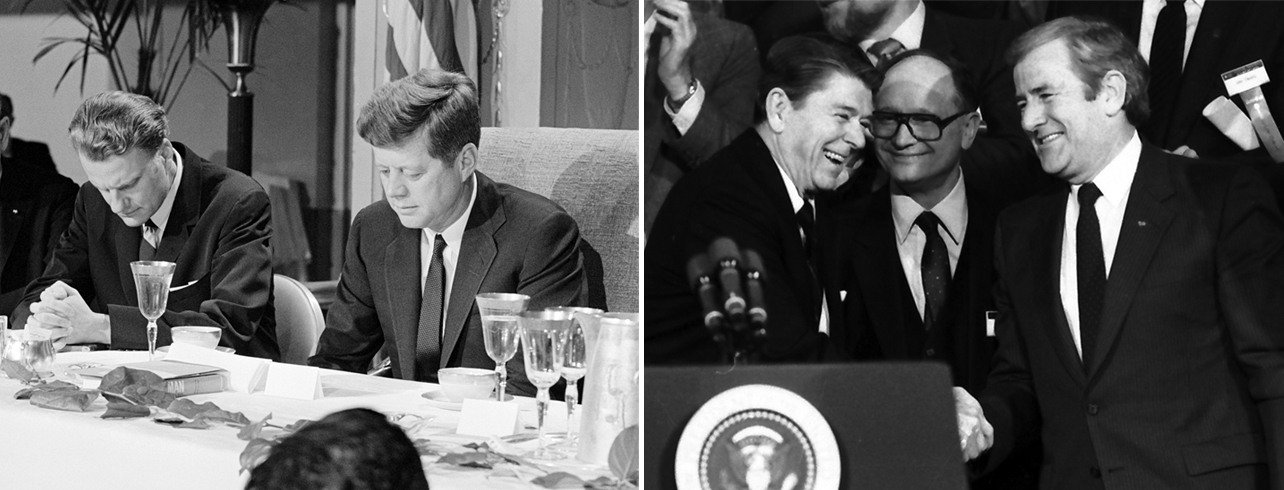
Equally a candidate, John F. Kennedy (shown at a 1963 presidential prayer breakfast) downplayed his faith. By the 1980s, the Religious Right, championed by Jerry Falwell (shown with President Ronald Reagan in 1984), was a major force in politics, pushing candidates to wear their faith more than openly. Bettmann/Corbis/AP Images (Kennedy), AP Photo/Ira Schwarz (Reagan)
Praying for Votes
When Jefferson was running for president, elections were very different from what they are today. Voting was heavily restricted (largely to wealthy white males) and political parties were not as established every bit they are at present. "You don't have candidates going around the country making speeches," says Schulman, "so personal statements of religion are actually non a function of political campaigns."
Ane effect that nudged candidates' personal organized religion further into the electoral limelight was immigration. As waves of Catholics began arriving from Europe in the early 1800s, religious tensions boiled. Protestants believed Catholics' loyalty to the pope above other authorities made them unfit citizens. That suspicion lessened over fourth dimension and with restrictions on mass immigration, says Schulman, but information technology was withal potent enough to force John F. Kennedy (Hon.'55) to openly address his Catholicism in a speech communication in 1960 to reassure a nervous public. Accused of being unpatriotic and a Catholic Communist, Kennedy downplayed his religion, assuring his audience of Protestant ministers that he believed "in an America where the separation of church and state is absolute."
But candidates didn't really begin talking most their personal religion to win office until after the 1970s, says Schulman. Opposition to the secularism of the '60s, to ballgame, and to measures that established a clearer separation between church and state, such as the banning of schoolhouse-sponsored prayer, galvanized the Religious Right. Evangelicals would boost the campaigns of Republicans like Ronald Reagan, George H. W. Bush (Hon.'89), and George W. Bush. At present, "the part of evangelical Protestants is then strong," says Schulman, that information technology shapes "the unabridged presidential selection process."
Today, near Americans want a president of faith. In a 2014 Pew Enquiry Eye survey, 53 percent of Americans said they would be less likely to back up a presidential candidate who does not believe in God. As contempo elections have shown, they also expect presidential candidates to talk about their personal faith.
"The rising of the Religious Right has changed the landscape and so that" in almost of the United States overt religious expression is an expected part of our politics, says Schulman, "and overt irreligion or non-religion is something that's get more or less unacceptable."
PLAYING THE Faith Carte
As they've watched religion help Republicans win the White House, Democrats have tried—with varying levels of success—to convince Americans they accept the spiritual chops worthy of the Oval Function.
"It was a pretty widespread perception that one reason John Kerry lost in 2004 was because he only couldn't convey any sort of faith to the American people," says Prothero. "He sort of seemed like a secularist, and people didn't similar that. [Information technology wasn't so much] that he was Catholic—it just seemed similar he didn't have any piety. Democrats now have learned from that, and they talk nigh religion a lot." He notes that the strategy of "Hillary Clinton and Obama has been to co-opt efforts past Republicans to merits the Christian curtain for themselves and [their efforts] to claim that at that place's simply one kind of Christianity."
Nosotros can await candidates to go on to play the religion card in 2016. Clinton volition "talk more about [religion] as the election moves on," he speculates.
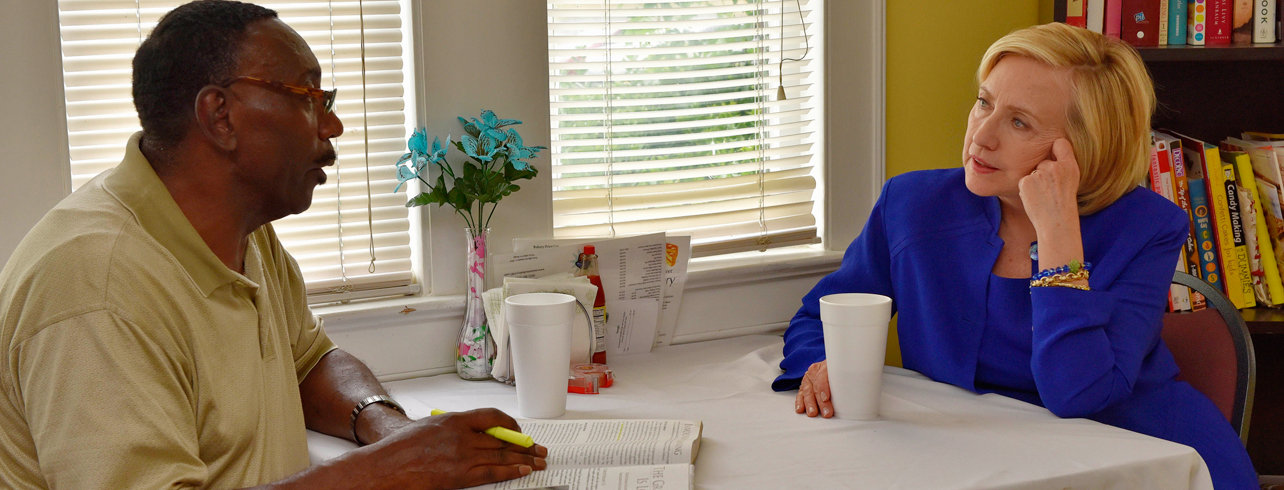
In May 2015, presidential candidate Hillary Clinton'southward Bible give-and-take with Frederick Chase, a Baptist minister, won her his support. AP Photo/Richard Shiro
If the Democratic Political party's challenge is knowing when to talk near religion, the Republican Political party'southward is knowing when to end talking almost it. A lineup including Mike Huckabee (an ordained Southern Baptist minister) and Ted Cruz and Ben Carson (both sons of ministers) guarantees stiff testimonies of faith and plenty of references to God and morality. But candidates similar these have to be conscientious: talking likewise much about religion and morals could cost them the Oval Office. Prothero, whose new book Why Liberals Win the Civilization Wars (Even When They Lose Elections) is due out in January 2016 from HarperOne, says he's joked that the Republican primaries could exist the all-time thing for the Democratic Party.
"Culture state of war politics is very successful on the right for state and local elections, merely information technology's not successful at the national level," he says.
Voicing opposition to problems such as abortion and gay marriage in the primaries might fire upward some GOP members, but tin make hopefuls "look like fringe candidates" to others—never mind voters beyond the confines of the party, says Prothero. Faithful Republic cites Republican Rick Santorum'due south failed 2012 presidential bid equally an example: the Catholic gained favor by opposing abortion and gay marriage, just non when he spoke out against contraception; he lost the nomination to Romney.
Prothero expects 2016 won't be much different, considering, he says, "in order to win the Republican nomination you have to appeal to cultural conservatives."
UGLY POLITICS
The boost that the culture war gave right-leaning politicians later on the 1970s contributed to the partisan politicking nosotros run into today, says Schulman. As he wrote in Rightward Bound: Making America Conservative in the 1970s (Harvard Academy Press, 2008), the "stern individualistic morality and apocalyptic, black-and-white worldview" of right-fly evangelicals like Jerry Falwell "proved more appealing than the nuanced perspective of evangelicals who focused on social-justice issues and on the ambiguities and pitfalls of partisan politics." Over fourth dimension, both parties politicized more than problems, from history and education to the environs and strange policy. Today, says Prothero, "we play out these culture wars non just in terms of abortion and in terms of same-sex marriage, but in all these fields."
"RELIGIOUS TERMINOLOGY, RELIGIOUS Language, AND RELIGIOUS WAYS OF VIEWING THE WORLD ARE GOING TO RUN THROUGH THIS Unabridged PRESIDENTIAL Election."
One squabble nosotros can expect to run across in the 2016 election concerns American exceptionalism—the idea that the U.s.a. has a unique function to play in history and in the earth. Exceptionalism rears its head in debates on almost everything from economic to foreign policy. Prothero says these clashes "can be read pretty straightforwardly about as theological debates nigh how covenantal theology works"—is God our critic or our backslapper?
Christians of both parties believe in the thought of America every bit a special, "promised land," an idea dating back every bit early on every bit the settlements of the Pilgrims and the Puritans. Simply they sometimes part ways on what it means to be a called people—and on the rhetoric for talking virtually it. Republicans, says Prothero, emphasize pride in the US as the greatest country in the world, wanting to come across the US demonstrate "moral superiority"—1 reason negotiating with Iran over its nuclear capabilities was such a bespeak of contention. Democrats, however, commonly speak in a prophetic mode about how the nation needs to practice improve at living up to its ideals of equality, justice, so forth.
TOGETHER, FOR BETTER OR WORSE
In the end, the politicization of religion could come back to haunt politicians—and church leaders. In fact, surveys of immature people show this to exist a contributing factor in the ascent of the religiously unaffiliated, says Prothero. These so-called "nones," expected to abound to roughly a quarter of the population in 2050, don't desire to be associated with a party—or politicians—they may not agree with. "I think the vitality of American organized religion has really been injure by the contempo push toward more than and more religion in the political space," he says. "And there are some evangelicals saying, 'Y'all know, we made a mistake. We need to exit of this political game, considering our make is existence injure.'"
But the entanglement of religion and politics can be used for skilful, as it was in the abolition and civil rights movements. And while voters in more secular countries are befuddled past the idea of voting for a candidate who waxes on almost Jesus, the miracle is in some ways a reflection of our nation's history of religious liberty. Since the U.s.a. "didn't have a state church, organized religion was actually able to thrive more here," says Prothero. Faith was freed, he explains, from the official political ties that damaged it in times of upheaval, similar the French Revolution.
For skillful or ill, the ongoing importance of religion in United states elections also shows that Americans still have a soft spot for organized religion—even if they're less probable to exist found in the pews. In 2013, more than half of Americans said faith was "very of import" in their lives and that information technology "tin can respond all or nearly of today's problems."
Historians are getting the message. Whether through new scholarship or exhibitions similar the Smithsonian's, they're working to integrate religion more deeply into their understanding of the land'south past—and present. "I call back function of the reason that at that place'southward been a new interest among scholars in the office of religion is the obvious question of trying to explain the world that we live in now," says Schulman. He and Prothero point out that religion is critical to understanding a broad range of recent events, from ix/11 to the success of Walmart, a company informed by the religious views of the Walton family.
"Events take sort of overtaken the secular bias among historians," says Prothero. Information technology'southward condign more difficult, he says, to ignore "that religion matters in American History."
Jefferson Lost
By now, several generations have grown up without public school prayer, and it'south like shooting fish in a barrel to take church building-state separation for granted. Just the idea that it is a defining feature of American public life is a myth, says Bruce J. Schulman, a professor of history.
Thomas Jefferson, in his famous 1802 letter to the Baptists of Danbury, Connecticut, described his view that the First Amendment created "a wall of separation betwixt Church building & State." But the firm wall Jefferson envisioned didn't materialize in his lifetime. "Jefferson lost," says Stephen Prothero, a professor of religion. "Jefferson's idea that religion should exist individual, that there should be a wall of separation between church and state—that was never the dominant thought."
"Religion has been deeply implicated in American politics since the founding," says Schulman, "for ameliorate or worse." Whether through the prayers of the Continental Congress or the 1956 declaration of "In God We Trust" as the national motto, religion has made its mark. In fact, it wasn't until the middle of the 20th century that the Supreme Courtroom officially confirmed the Beginning Subpoena as creating that wall—a watershed moment that paved the way for subsequently decisions, including the banning of school-sponsored prayer.
Jefferson image courtesy of Library of Congress
Source: https://www.bu.edu/cas/magazine/fall15/america/
0 Response to "The Office of the People in Art Government and Religion"
Post a Comment