What Baby Brands I Can Export to Europe
Some of the globe's near interesting apparel markets are in Europe. This study will help yous understand what the most of import requirements are to be successful in the European market place for baby habiliment, which is known for its fashionability. Collections and designs are more often than not very detailed and challenging to manufacture. You will observe babe wear buyers in every channel and market segment. Even so, be aware that there may be different requirements in styling and quality among buyers from unlike EU countries.
1. What requirements must babe wear comply with to exist immune on the European market?
If y'all want to sell baby wear in the European market, you need to comply with several requirements, some of which are mandatory, whether they are legal requirements or not. Others are voluntary, merely meeting them tin requite you a competitive reward. Some requirements only apply to certain niches in this marketplace.
Mandatory requirements
There are several legal requirements you need to comply with if you want to consign baby habiliment to Europe, including requirements concerning product prophylactic, the use of chemicals (Attain), quality and labelling. Additionally, many buyers have created not-negotiable terms and conditions for all their suppliers to comply with. These requirements are non required by law, only all the same mandatory.
Product condom
Whatsoever item of babe wear for sale in the European union must comply with the European union's General Product Safety Directive (GPSD: 2001/95/EC). European Wedlock Member Countries will check if your product meets the applicable safety requirements.
If your buyer has supplied the product design, information technology is their responsibility to brand sure it is legally safe for consumers to use. Notwithstanding, if you have whatever doubts about whether a design is not compliant with the Eu's General Product Prophylactic Directive, hash out it with your buyer before you first the product process.
Special requirements for baby article of clothing
The EU has a specific standard for the safety of children'due south and baby wear. This standard contains requirements to ensure that cords and drawstrings are placed safely on apparel for babies and children upwards to 14 years. This is to avert strangulation and choking hazards.
Tips:
- Do not use cords or strings in the cervix area of infant wear (hoods are allowed).
- Practise not use accessories like buttons that can come loose and crusade a choking take a chance.
- Perform a small-scale parts cylinder test to check which parts are allowed, such as this online example of a small objects tester.
- Check the Eu's 2019 Guidance Document for actress information on rubber requirements for children's and baby habiliment.
Achieve
Whatever item of baby wear exported to the Eu must comply with the REACH Regulation, which stands for registration, evaluation, authorization and restriction of chemicals. This regulation restricts or prohibits altogether the use of many chemicals in clothes and specific materials used for trims.
Chemicals normally used in clothes production, which are restricted nether REACH include:
- azo dyes that may release one or more of the 22 aromatic amines listed in Appendix viii to the Reach Regulation, nonylphenol and nonylphenol ethoxylates, and heavy metals, such as mercury, cadmium and pb;
- waterproofing and stain-repelling chemicals, such every bit perfluorooctane sulfonic acid and its derivatives (PFOS), which were originally restricted under REACH, but are now restricted nether the Stockholm Convention (EU Regulation 2019/1021), as well equally other persistent organic pollutants (POPs);
- certain nanomaterials used to brand fabrics antibacterial;
- nickel, a restricted compound in metal trims and accessories, such as zippers, buttons and jewellery;
- polycyclic-aromatic hydrocarbons (PAHs) and phthalates used in plastic and PVC parts.
Restricted substances lists (RSLs)
In addition to REACH, many brands and retailers have formulated their own restricted substances lists (RSLs), which are stricter than REACH. They are often inspired by the guideline on the use of safe chemicals from the Cypher Belch of Hazardous Chemicals (ZDHC) foundation. Download the ZDHC Conformance Guidance to larn how to comply with the ZDHC guideline.
Flammability
The Eu has no specific legal requirements regarding apparel flammability, but several EU Member Countries accept their own, including the UK, Republic of ireland, the Netherlands. Switzerland, not a member of the EU merely office of the European union single market, also has its ain requirements. The European union has a voluntary standard on burn down resistance of the children's nightwear, which may aid in compliance with the GPSD.
If you use flame-retardant chemicals in your apparel, exist aware that you need to adapt with the Attain Regulation for the use of chemicals.
Labelling your product
You must specify the material content of every item of baby article of clothing that you lot export to the EU, in accord with EU Regulation 1007/2001. The purpose of this regulation is to let consumers know what type of dress they are buying.
Labelling the country of origin ('Made in') or labelling care instructions is not notwithstanding legally required in the EU. Including care labels in your babe wear is highly recommended though. Consumers expect information technology, specially because baby wear can get dirty rapidly.
ISO 3758: 2012 is the preferred standard for care labelling. The care label symbols are property of the company GINETEX. You need to pay a stock-still compensation to GINETEX for the use of these symbols.
Intellectual belongings rights
If you lot are selling your own designs in the European market, you must make sure you are not violating whatsoever intellectual holding (IP) rights. If your buyer provides the design, they will also be liable in case the item is establish to violate a property correct.
Complying with intellectual property rights besides means you cannot copy nor share designs from one buyer with some other. European buyers await yous to handle their designs prudently.
Non-legal mandatory requirements
In addition to the legal requirements mentioned higher up, you may exist required to comply with non-negotiable terms and conditions that buyers have created for their suppliers. Such requirements are not required by law, but they are still mandatory.
Sustainable production and social responsibility
Many buyers in Europe are increasing their demands in relation to sustainable product and social responsibility. At the very to the lowest degree, buyers will enquire y'all to open your factory doors for them, so they can carry personal inspections of your factory. Additionally, you lot may be requested to comply with the post-obit independent standards:
- Standard 100 by Oeko-Tex is the most widely required standard regarding harmful substances and sustainable product. European buyers may also crave standards such as the EU Ecolabel, BCI (Better Cotton Initiative), GOTS (Global Organic Textile Standard) and Bluesign.
- Regarding social responsibility, BSCI (Business Social Compliance Initiative) is the most popular certification that European buyers require. Other popular CSR standards include FWF, WRAP, SEDEX, ETI, SA8000, ISO 26000, and Fair Trade.
Garment intendance preferences
When selecting base materials for baby wear, go for easy-to-care fabrics that can exist car done at high temperatures (sixty°C minimum) without the take chances of shrinking or fading. This is i of the reasons for the widespread utilise of cotton in baby wear.
Packaging requirements
Your buyer volition give you instructions on how to bundle the order in most cases. If you lot concord with your heir-apparent that they will clear customs in the country important, which is the norm in the clothes industry, it is their responsibility to make certain the instructions comply with Eu import procedures.
The packaging instructions will be written downwardly in a packing manual, where you will find all relevant packing instructions concerning:
- type and quality of the packing cloth you need to use;
- size of the packing material;
- information that should be mentioned on the packing fabric, including style references and numbers, size breakdown, number of pieces and colourways;
- placement and position of barcodes;
- way of stacking;
- maximum quantity in a box or polybag;
- maximum weight of an export carton;
- nominated suppliers for the packing material.
Your buyer will too appreciate any efforts you lot brand to reduce the ecology impact and the financial cost of using packaging materials. First, y'all tin brand suggestions on how to apply less packaging materials. Another selection is to apply environmentally friendly alternatives, such as recycled and biodegradable materials.
Payment terms
Ordinarily, European buyers volition pay you a percentage of the total sum of the society, for example, 30% of information technology when they place the gild, and the rest (70% in the example) after the club is completed. The most used payment method in the apparel industry for such a transaction is the letter of credit (LC). An LC obligates a heir-apparent's banking company to pay the supplier when both parties run across the weather they have agreed upon.
In other cases, a heir-apparent might ask for a telegraphic transfer (TT) later on 30, 60, 90 or sometimes even 120 days. This ways you, as a manufacturer, finish the product and hand over the shipment to the buyer, including the original documents earlier payment is due. The payment volition exist made after the number of days that you have agreed on with the buyer. This is a risky payment agreement because you lot accept total financial gamble.
Tips:
- Read the CBI study Organising Your Exports to Europe, for more tips on how to bargain with payment terms, storing, packaging and shipping.
- Check the Eu'southward Trade Helpdesk for an overview of all legal requirements set up for your product. There you can place your production lawmaking to become a list of the applicative requirements.
- Familiarise yourself with the complete list of chemicals restricted under Attain. Make sure you merely piece of work with suppliers of fabrics and trims that are Attain compliant. Ask for proof that they are. Even so, perform random production tests to ensure your supplier is indeed delivering REACH-compliant fabrics and trims. Ever use a certified testing laboratory. The most used competence standard for laboratories is ISO/IEC 17025.
Additional Requirements
In addition to non-legal, but mandatory requirements similar standards and certifications, there are many services that buyers implicitly expect or at least highly appreciate if you desire to do business with them. These requirements can differ from heir-apparent to buyer.
Product design and development
Most buyers have their own design team and practice not solely rely on the collections that factories nowadays to them. Withal, having your own ideas on product blueprint and development volition be highly appreciated. Buyers are always looking for special designs, materials and product methods to help them stand out in the market.
Features that European buyers of baby habiliment highly capeesh include:
- the use of chemic-free, hypoallergenic, sustainable materials;
- ease of washing at loftier temperatures;
- resistance to staining during wear;
- innovations in getting garments on and off easily.
Communication
Smooth communication is an implicit requirement of all buyers. Always respond to every email inside 24 hours. Even if information technology is just to confirm that you accept received the email and volition transport a more than consummate respond later. If you accept a problem with a product lodge, immediately notify the customer and effort to offering a solution. Another skilful tip is to create a T&A (time and arrival) of every lodge and share it with your buyer. This file will help you to manage expectations, monitor progress and is the all-time guarantee of on-fourth dimension delivery.
Flexibility
Many factories focus only on getting convenient orders: simple designs, big quantities and long delivery times. However, if you want to outset a account with a European buyer, exist prepared to have complicated orders start. Buyers will want to test your manufactory before giving y'all large, easy orders. Make sure at the start that a buyer will not continue to place only difficult orders with yous and user-friendly orders elsewhere.
Look a European heir-apparent to require in their offset lodge:
- high cloth quality and impeccable workmanship;
- order quantities below your normal minimum club quantity (MOQ);
- a toll level that is lower than you normally would accept for small quantity orders.
Tips:
- Read CBI'due south seasonal Way Forecast or sign up for trend forecaster WGSN's newsletter. For inspiration and trends in baby wear, check online fashion platforms as CWB, Kid's Vesture Magazine and Earnshaw's, which European buyers also read.
- Check the websites of Fashion for Good and Springwise, search for 'apparel' or 'style' in the search bar, for the latest innovations in apparel design and production.
- Invest in in-house printing and embroidery equipment to ameliorate control quality and delivery speed.
Niche requirements
The following requirements appeal to a minority of buyers in Europe, but they may give you lot a competitive advantage.
Sustainability
Check out parenting forums and blogs, such as Mother and Baby, for the latest data on sustainable brands gaining popularity. Investigate what their products have in common and look for niches where yous tin can develop unique, distinctive products. Some smaller brands produce only baby wear or for babies and children upward to their pre-teens. These tend to be premium, high-quality brands focusing on environmentally friendly materials.
Gender-neutral collections
Brands and retailers do not typically segment past gender. There is a growing tendency for durable, gender-neutral habiliment using quality materials, neutral greens and yellows, as well as prints that practice not restrict utilise according to gender. John Lewis is an instance of a private label brand moving towards more gender-neutral clothing for children. Hema likewise launched gender neutral children'south underwear.
Tips:
- If you decide to focus on a niche, investigate the specific requirements and make sure you lot tin can comply with them. Be aware that gild quantities in niche markets may exist pocket-size.
- Try to think alee in your product development if yous service niche markets, where innovations are introduced virtually daily. Try to notice workable innovations that will non only give you lot the tools to diversify but too to cut expenses.
- Read more about voluntary standards, including fair production in the ITC Standards Map database.
ii. Through what channels tin you go baby wear on the European market?
Before you lot start to arroyo European buyers, y'all need to determine what market segment fits your company all-time and through what channels you desire to sell your product.
How is the end marketplace segmented?
European buyers of baby wear can all-time be classified past the price-quality level of their products. Other than that, each target age group is generally associated with product characteristics such as soft, chemic-free and natural materials for babies.
Tabular array 1: Infant wearable market segmentation
| Consumer type | Price level | Fashionability | Materials | Functionality | Gild quantities |
| Luxury consumer | Very high retail prices | 'Adult', unique designs | Luxury materials | Very high requirements regarding washability, durability and fit | Low order quantities |
| Fashion conscious consumer | Loftier retail prices | Styles in line with latest trends | Good quality, organic materials | High requirements regarding washability, durability and fit | Low to medium society quantities |
| Practical consumer | Medium retail prices | Practical, fashion conscious designs | Medium quality, organic materials | Requirements include easy-to-wash, condom | Loftier order quantities |
| Cost-witting consumer | Low and extremely low retail prices | Use of licensed graphics | Medium-low quality materials | Requirements include easy-to-wash, safety | Loftier society quantities |
The luxury consumer
European brands in the luxury marketplace like Burberry, Baby Dior, Fendi Kids and Dolce & Gabbana sell highly stylish collections at very high retail prices. Buyers in this segment accept extremely high standards regarding safety, washability, immovability, fit and use of luxury materials, making this a very difficult market to enter. Order quantities are depression. This market place is growing primarily considering European couples are starting families afterward in life and therefore tend to have higher disposable incomes when they have children.
The fashion conscious consumer
The upper-middle market place caters to the manner conscious consumer. Information technology is home to brands and retailers such as Joules, Petit Bateau, Tumble N Dry and Bonpoint. Some cater to both adults and children, others specialise in children's and infant clothing. Styles are in line with the latest trends in colour and design. Retail prices are loftier. Focus is on safety, washability, durability, fit and high-quality organic materials. Gild quantities are low to medium. This market is growing, for the same reason the luxury market is growing.
The practical consumer
Practical consumers typically shop in the middle market. Here y'all will find brands and retailers such equally Zara, G&South, Benetton Kids and IKKS. They sell practical, fashion-conscious items, sometimes using licensed graphics. Focus is on safety, washability, durability, fit and medium-quality materials. Buyers will regularly require organic fabrics. Society quantities are loftier, retail prices low. Similar many center markets in Europe, this segment is brackish.
The price-conscious consumer
The budget market place has brands and retailers such every bit Tesco, HEMA, H&M and Carrefour catering to price-conscious consumers looking for non-branded, applied items and basics that are good quality, easy to wash and safe. Buyers oft use licensed graphics in their designs. Organic materials are in small demand, with notable exceptions, such as C&A and Zeeman. Social club quantities are high and retail prices are very low, so your margins would be likewise. This market is growing.
Table 2: Selected European infant wear buyers and their position in the market place
| Company name | Price-quality level | Fashionability | Society quantities | ||||||
| depression | med | high | bones | med | high | low | med | high | |
| Burberry | x | ten | x | ||||||
| Babe Dior | 10 | x | ten | ||||||
| Fendi Kids | x | 10 | x | ||||||
| Dolce & Gabbana | x | x | x | ||||||
| Joules | 10 | x | x | x | ten | ||||
| Olivier | ten | 10 | x | ten | x | ||||
| Petit Bateau | 10 | x | 10 | x | x | ||||
| Tumble N Dry | x | 10 | 10 | x | x | ||||
| Bonpoint | x | 10 | x | 10 | x | ||||
| Zara | x | x | x | ||||||
| M&S | x | x | x | ||||||
| Benetton Kids | x | x | ten | ||||||
| IKKS | x | ten | x | ||||||
| Tesco | x | x | x | ||||||
| HEMA | x | ten | ten | ||||||
| H&M | x | x | x | ||||||
| C&A | x | ten | x | ||||||
| Carrefour | ten | x | ten | ||||||
| Zeeman | x | x | x | ||||||
Tips:
- Cheque online shopping platforms for baby vesture, such every bit Kleertjes, Babyccino and Proper name It, for inspiration on styles and colours.
- Focus on adding value for higher segments which offering higher turn a profit margins. If you are offer practiced-quality organic products, make sure your products are fashionable and differentiated in some manner, for example, past focusing on original graphics or by ownership a licence for creating unique character prints.
- Note that a babe collection is non only about garments. Attempt to develop side products and accessories, perhaps even made from cutting waste to help you abound your market share.
Through what channels does the product end upwardly on the end market place?
The well-nigh marked difference amongst your potential buyers is their place up the value concatenation, considering that will determine how they practise business with you. Each type of heir-apparent requires a specific approach. Always try to observe out in what part of the value concatenation your heir-apparent operates, what challenges they face up in the market place and how you can contribute to their sales strategies.
- If you want to target European end consumers direct, try selling via platforms such every bit Alibaba, Wish and Amazon. Most online consumers tin can be plant in countries in Europe'south northwest. Yous will need to invest in a spider web shop, stock and order management, and customer service. Your biggest challenge will be render policies. The lack of brand sensation among European consumers, who appreciate baby habiliment for its consumer safety and sustainable qualities, will also make it hard to observe buyers exterior the budget marketplace.
- Online multi-make retailers such every bit Zalando, Asos and Yoox sell infant clothing brands and develop their own private collections, more often than not value brands. They can observe market involvement very fast and will immediately react upon sales data. Normally such companies volition place a minor test gild outset. If the particular is selling well, they will place an actual production society. Fast delivery is a must.
- If you want to sell to retailers, the biggest names in babe wear are H&Chiliad, Zara and C&A. Many large supermarket bondage also sell baby wear. A retail buyer can place an order relatively fast equally they but demand one development sample for society confirmation. However, their buying behaviour can be unpredictable. Gild quantities are large when you service Europe's big retail chains, just so is the price pressure.
- Baby wear brands such as Le Petit Bateau and Olivier typically develop a collection 12 months in advance. You will need a large sample room as brands require salesman samples (SMS) of each drove style. Every sample needs to be bodily, meaning it must expect exactly like the production will in the shop, with branded hangtags and accessories. Information technology may have many months before orders are placed. Brands sell to retailers, but likewise direct to consumers via their own online stores.
- Intermediaries such as agents, traders, importers and individual characterization companies, sell your product on to buyers up the value concatenation. They are price focused and crave flexibility in quantities and qualities. Some are located near or in the production countries and primarily exercise sourcing and logistics, such as Li & Fung. Others, such as Dewhirst and Longratex work from Europe and besides do market place research, pattern and stock keeping. Their service level determines the committee rate they charge.
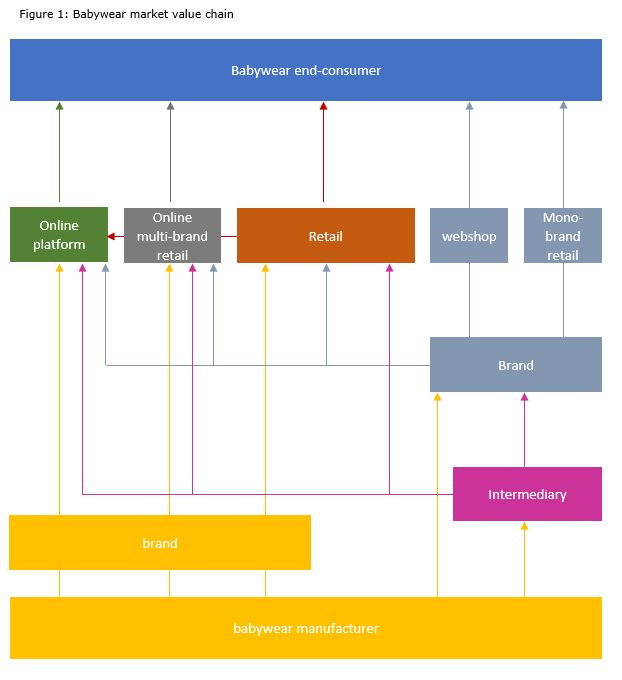
What is the most interesting aqueduct for y'all?
If you are a minor to medium-sized manufacturer in a developing land, intermediaries, brands and retailers are probable the most interesting types of buyers for you. Terminate consumers are a difficult target group because of complicated customer service demands and your lack of brand sensation. European retailers tin be a difficult channel because they generally purchase from brands and traders.
Intermediaries
Agents, traders, importers and private label companies are the most adventurous type of buyer and are usually the first to explore new sourcing destinations. By working with an intermediary, you will have access to many different buyers upwardly the value chain and you can learn how to service them by following the trader'southward instructions. At the aforementioned time, you lot avoid the risk and investment associated with directly supplying to a brand or retailer.
Brands
Many European fashion brands are trying to cut out intermediaries and source directly from manufacturers. Baby habiliment brands are no exception to this trend. Hence, brands can be an interesting category of buyers. Nevertheless, working for a brand comes with greater risk, as requirements become more stringent the higher you lot go up the value chain. Your kickoff difficulty will be to get nominated past a brand. Investigate your potential buyers' target group and collections and try to offer a amend product for a competitive price.
Retailers
Selling to a European retailer with a local buying function in your region gives you the advantage of doing business concern with a partner that knows the trends and requirements in the European market. The choice between doing business organization with an intermediary or a retailer mainly depends on the complication of the product y'all produce. Basic, cheap items practice not offer enough margin to justify working with an intermediary.
Tips:
- You tin find traders specialised in baby clothing by using an online search engine. Use keywords such as 'full service', 'garment' or 'baby wear' plus 'solution'. Traders websites usually prove the brands they work with.
- Check European sector associations for contacts. Formed past several national children's fashion associations, Children's Fashion Europe promotes the interests of children's fashion companies in Europe.
- Follow potential buyers on social media channels, such as LinkedIn, Youtube, Twitter and Instagram. This will provide you lot with company updates and news on their latest collections and travel schedules. They might also follow you in return.
3. What competition do yous confront on the European baby wear market place?
Large and small factories in Asia, Due north Africa and Europe are your main competitors. If you want to compete successfully, information technology is of import that yous can handle flexible quantities; that you have a reliable, transparent and preferably local supplier of organic materials; and that yous have loftier efficiency and low wages. This is because prices for baby clothing are lower than for adults, but labour intensity and wastage are usually the same or higher.
Which countries are you competing with?
People's republic of china is the largest land exporter of baby article of clothing to Europe. Technical innovation, high efficiency, excellent customer service and the local availability of fabrics and trims give Chinese manufacturers an reward over competitors in developing countries. Most factories comply with European requirements regarding quality and sustainability, but high MOQs, rising labour and product costs and not benefitting from the Generalised Scheme of Preferences (GSP) that removes import duties to the EU, all work against them.
Producers in Bangladesh specialise in making cheap, basic clothes, including baby vesture. The land benefits from a large, fairly well-skilled workforce, low labour costs and benefits from the GSP. There is piddling availability of local cotton wool. The biggest challenge for People's republic of bangladesh will be to increase technical expertise, facilitate smaller orders and get more factories to comply with international safety and sustainability standards.
India is a depression-toll producer of dress with a large workforce. India's dress production is by and large divided into hubs based on product type, with the one around Delhi focused on womenswear and children's wear. Republic of india, which benefits from the GSP, is the world's largest producer of cotton and second-largest exporter, but many of its factories lack the service level that their competitors in Communist china offer, and are struggling to encounter increasing requirements regarding sustainable product.
Turkey has the main advantage of being shut to Europe, which results in very short lead times. The country produces high-quality, stylish apparel items in small quantities, including babe clothing. It has local availability of cotton and a European concern culture. Among other advantages, Turkish manufacturers will accept payment in euros, for example, just price levels are relatively high compared to countries in Asia.
Although Sri Lanka'due south wages are increasing, it remains a low-cost sourcing origin with a skilled workforce and efficient, compliant factories. Sri Lanka's producers focus on higher added-value products, including upper marketplace casualwear, women's lingerie and nightwear, swimwear, children's and babe wear. Sri Lanka lacks locally produced fabrics, only information technology benefits from the GSP+ tariff scheme.
Cambodia is an upcoming product land for dress, including children's and babe wear. Many factories in Kingdom of cambodia were ready by foreign investors from other Asian countries, who likewise bring their expertise. The country lacks locally produced fabrics, merely benefits from the EBA tariff scheme. Sub-optimal product quality due to an inexperienced and relatively pocket-sized workforce and the relatively high costs for importing and exporting fabrics and finished appurtenances work against Cambodia'southward producers.
Tips:
- As a manufacturer from a developing country, consider targeting higher value segments and value-added product groups, rather than using simple styles in the overcrowded, low-cost, low-margin value segment.
- Investigate other wearing apparel producing countries for their competitive advantage. Check the freely accessible CSR Take a chance Bank check database to detect the social and ecology risks associated with apparel product in different countries, including your ain. Use this information to mitigate risks and to promote the advantages of sourcing in your country.
- Before you lot approach any buyer, decide your USPs and define your ideal buyer. Note that selling your company is even more important than selling your product, then focus on certifications and CSR. For more information, read our written report on trends in the European apparel market.
Which companies are you lot competing with?
The Crystal Grouping is a large, well established manufacturing group with twenty factories in v countries (Red china, Bangladesh, Sri Lanka, Kingdom of cambodia and Vietnam). Central to its success is what it refers to as its co-creation business organisation model, which focuses on building long-term relationships with leading global apparel brands and working as a proactive partner in both innovation and sustainability.
The Crystal Grouping offers splendid service, including dedicated production teams to suggest buyers on product specifications, raw materials, finishes, treatments and washing techniques, and fifty-fifty monitoring heir-apparent's stock levels at their warehouses.
Communist china'due south Jiangsu Guotai Huasheng Industrial Co. Ltd has seven production units in China and four in other countries (in Myanmar and Cambodia). One of the largest Chinese exporters of apparel, and part of a large grouping, Jiangsu Guotai is vertically integrated, producing its own yarn, fabric and trims. The company offers design and a sample making centre for fast turnaround of prototypes. Information technology also has sales offices in European countries, such every bit the United kingdom of great britain and northern ireland, France and Spain.
Sri Lanka's Voguetex has a sales office in Germany, which provides the advantage of being close to buyers and to offer localised service and support. Voguetex focuses on customer service, including product development, design, in-house printing and embroidery, and marketing. Its website is professional person and modern and is supported by an agile presence on social media. The company clearly promotes its focus on CSR, including local community initiatives and certifications, such equally BSCI, Sedex, Oeko-Tex and ISO 9001:2008.
Tips:
- Check the gratis online database Open Apparel Registry, which allows you to look up the suppliers of hundreds of European fashion brands, including buyers of baby article of clothing.
- Study your competitors and endeavour to empathise why European buyers are interested in placing orders with them. Understanding your competitors will help you lot to diversify and amend your own USPs.
- Read the CBI study x Tips for Doing Concern with European Buyers to learn how to approach and appoint with buyers. This written report also describes how yous can get practical help with understanding European business culture, analysing your USPs and doing business with European buyers.
- Loftier levels of quality and service alone will not necessarily lead to growth. A professional person approach to marketing and sales is essential. Create a professional website in English and promote your capabilities by attention trade fairs or establishing sales representation in Europe.
Which products are yous competing with?
Printed and embellished dress items, specially those with licensed graphics, fetch higher prices than solid items. The biggest emphasis on prints is in baby sleepwear, followed past tops. The near important product categories for comic book graphics are sleepwear, T-shirts and sweatshirts.
Short and long-sleeved T-shirts, leggings and sleepwear are worn year-circular past all age groups. In the value and center segments, a fashion is ofttimes sold in sets of 2, 3 or 5 colours or blueprint combinations for a lower per unit of measurement cost, specially for babies. There is intense contest for very low prices in these categories. In other segments, margins are college for value-added, embellished and sustainable products.
Organic materials are growing increasingly of import for baby onesies, T-shirts, sleepwear, sweatshirts, knitwear and leggings. As the industry move towards other sustainable materials, such as recycled fibres, more opportunities for outerwear garments using recyclable synthetic fabrics open up up.
Although largely seasonal, outerwear is a highly differentiated category focusing on both fashionability and functionality. Weatherproofing against both common cold and moisture conditions is important for all age groups with parkas, raincoats, puffer jackets and snowsuits in loftier demand. New materials and technologies are being introduced continuously, including shower resistance, h2o resistance, waterproofing and synthetic down.
Many of the top babe habiliment importing countries are cold-atmospheric condition countries, which ways that even in jump and summer, lightweight outerwear is required, making this a very interesting category for the European marketplace.
Tips:
- Try to meliorate your USP by offering baby wear with licensed graphics.
- Investigate the market demand for sustainable fabrics and try to offer sustainable innovations to create a product USP.
- Follow high-level baby habiliment brands like Le Petit Bateau and Olivier on social media, such as on Instagram, for inspiration and guidance on understanding market place trends.
four. What are the prices for babe clothing on the European market?
The factory price of your production, which in the manner industry jargon is your FOB price (for free on board), is influenced by many factors, including the cost of materials, the efficiency of your employees, your overhead and profit margin.
The challenge with manufacturing baby wear is keeping production efficiency high, fifty-fifty though the boilerplate fabric consumption may be lower than for adult article of clothing, and the club quantities smaller. Because of this, most successful manufacturers specialise only in infant vesture, maximising efficiency and competitiveness.
The following chart shows the average cost breakdown of a typical Fob price.
Chart ane: Breakdown of a typical Play a trick on price

Note that these percentages may vary per manufacturing plant and per order. Some factories accept lower profit margins during offseason periods or when social club volumes are high. In addition, the percentages for labour versus fabrics may vary, depending on the efficiency and wage level of the workforce and the price of the materials. Efficiency goes upwards and material prices go down when producing large book orders.
Retail pricing
The retail toll of a baby wearable detail is on boilerplate four to eight times the Play a trick on price, which is called retail markup. Information technology follows that the FOB price is on average 12.v%–25% of the retail cost of the production. Exceptions practice exist. In the upkeep market, some large European retail chains may sell products for a markup of just twice the Pull a fast one on toll. Retailers marker the Trick price up iv to 8 times considering they demand to account for import duties, transport, rent, marketing, overhead, stock keeping, markdowns, VAT (15%–27% in Eu countries), amidst other costs.
According to Eurostat's 2018 comparison of retail prices for wearing apparel, France has the highest cost level among the top vi clothes and footwear importer countries at 109.9 points compared to the European boilerplate of 100, followed by Belgium (106.four), holland (106.three), Italia (101.ane), Federal republic of germany (99.1), the Uk (92.seven) and Espana (92).
Note that brands and retailers that sell in multiple European countries usually go on prices equal or deviate simply slightly from the standard retail price. Prices for older children's garments are higher than those for younger children and babies. Some retailers even have a tiered pricing system for larger sizes within the same age group for the same product.
Online commerce, a strong budget segment and intense contest have made consumers in Europe accustomed to depression prices. Focus on sustainability and higher product costs have, at the same time, put manufacturers, suppliers and buyers under enormous price pressure.
Prices are expected to remain stable in the next iii years thanks to increased efficiency, automation and the tendency of production shifting to low-wage countries. This tendency, combined with the increase in average population historic period and consequent decreasing need for infant wear, is expected to reduce average guild quantities, moving part of the production towards nearshore countries that tin can offering nearly flexibility.
This study has been carried out on behalf of CBI past FT Journalistiek.
Please review our market information disclaimer.
Follow us for the latest updates
Source: https://www.cbi.eu/market-information/apparel/babywear/market-entry
0 Response to "What Baby Brands I Can Export to Europe"
Post a Comment