History of Alsace Lutheran Church, Reading Pa
The origins of the Lutherans in French republic

The ideas of Luther (1483-1546), which became known from 1516-17, spread to France equally soon as 1521 (the Meaux circle) ; the first Protestants were called lutherans. Luther'due south ideas often started in humanist circles and caught on quickly because of reformers such every bit Guillaume Farel. The reformed Churches in France were established mainly by Jean Calvin, who had lived in Strasbourg before moving on to Geneva.
However, from the starting time of the Reformation movement onwards, the Lutheran Churches were ready on a permanent basis in ii regions belonging to the German empire which are at present part of France : Alsace and the county of Montbéliard, which belonged to the knuckles of Wurtemberg and where French is spoken. Even at the revocation of the Edict of Nantes in 1685 the protestant service connected to be held there.
In Paris, for over 2 centuries, the merely protestant service to be allowed was Lutheran because it was attended by foreigners passing through the city and past immigrants. There were two waves of immigrants who gradually fabricated up the Lutheran community : the first was from the XVIIth century onwards and especially in the 18th century, when skilled craftsmen came from Federal republic of germany (some of whom were excellent cabinet makers) ; the 2d was in the XIXth century when workmen came because they had been attracted to the speedily developing majuscule ; later on people from Alsace arrived who had been forced to get out their province because it had been annexed by Germany afterwards the Franco-German state of war in 1870-1871.
The Church of the Augsburg Confession
From 1802 onwards, in the "organic Manufactures" Napoleon Bonaparte, the First Consul, authorized the celebration of protestant reformed and Lutheran services. Alsace and the region of Montbéliard were able to keep the statute which applied particularly to their Church : local consistories, which were gathered together into inspections, organized past pastors who were ecclesiastical inspectors with the assistance of laymen, supervised by a college consistory established in Strasbourg, whose president was appointed by the State. So, unlike the reformed Church, the Lutherans were in the enviable position of having the united Church building of the Augsburg Confession (Eglise de la Confession d'Augsbourg).
In Paris there had been no Lutheran service since 1806 when Napoleon close downwardly the chapel in the Swedish embassy where protestant services had been held since 1626. However the Lutherans insisted that they had well-nigh 10,000 members in Paris and with the back up of general Rapp, a petition was made to the emperor for a place of worship. In 1808, he established the consistorial Church of Paris, which was continued with the Temple-Neuf in Strasbourg and they were given the Church building of the "Billettes". In 1853 the Church of Paris became an Inspection.
The 1870 war
-
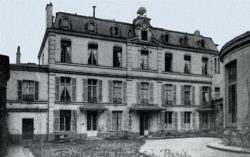
Protestant Kinesthesia of Theology Paris © SHPF
In 1871, Alsace and the Moselle became German territories ; the Inspection of Paris and Montbéliard were cut off from Strasbourg, their main Church building and their university of theology. At a synod, held in Paris in July 1872, the During the 19th century, the term is adopted past members of the Revival Movement. Nowadays, the Lutheran and Reformed Churches are referred to as historical churches, while the term evangelical is applied to churches that have their origin in the Revival Movements of the XIXth and XXth centuries." class="glossaryLink">Evangelical Lutheran Church building of France was established, which consisted of two ecclesiastical inspections :
- In Montbéliard, where after a while information technology was no longer a bulk Church;
- In Paris, where in that location were Lutherans of German origin, church building members from Alsace who wanted to remain French and also Church members from Montbéliard.
The synod voted a Constitutionaccording to the synodal structure, with parish councils set upwardly in 1852 ; information technology was officially recognized by law on anest of August 1879.
Immediately the Church asked for a theology academy to be set up in Paris which would exist both reformed and lutheran. A prescript in March 1877 prepare the kinesthesia which was congenital in Boulevard Arago on a plot of state belonging to the Town of Paris – it opened its doors in 1879.
Lutheran theology
The four pillars of Lutheran faith are :
- Solus Christus, Christ is the only Saviour,
- Sola gratia, he has saved united states of america entirely through grace,
- Sola fide, faith is all we need to receive this grace,
- Sola scriptura, the Bible is our only guide towards faith.
The Apostles Creed is the basis of the Confession of faith. The key Lutheran texts are the Confession d'Augsburg written in 1530 and The Small Canon past Luther.
Similar other protestant Churches, the Lutheran Churches take 2 sacraments :
- Baptism, an act of faith and a sign of the love of Christ ; it denotes the entry of a believer into the Church. Minor children, adolescents and adults tin all be baptized ;
- the Last Supper takes place during the act of worship and is presided over by an ordained priest. The consecrated bread and wine enable us to draw virtually to the body and blood of Christ, the living Word, which is essential for our whole being. All baptized Church building members who hold Jesus Christ to be their saviour are allowed to participate. This deed of religion brings usa into an intimate human relationship with Christ and information technology is a way of also sharing our faith with our neighbour.
The Lutheran Church attaches great importance to the building up of unity amongst Christians in the world. They have kept to a liturgy which comes partly from the rites of the Cosmic Church and they take themselves added chants and gestures which are in harmony with Catholicism. For example the body of Christ remains on the Cross in a higher place the chantry and some pastors do the sign of the cantankerous when they face the congregation.
The EELF in 2012
In 1906, due to the 1905 law separating the Church from the State, the EELF already took on its present form, as an official religious association, whereas the diaconal associations were set according to the law of 1901.
In the same way as when information technology was first established, the EELF today consists of two regional ecclesiastical inspections :
- The inspection of Montbéliard : there are iii counties (or "departments") the north of the Doubs, the Belfort region and the north of the Haute-Saône. There are 35,000 members in 31 parishes,
- The inspection of Paris covers the balance of French republic, not counting Alsace and the Moselle which have remained under the concordatory organization. Its parishes are in Paris (nigh ten of them), likewise around Paris (some other ten), Lyon and Nice. There are most 6,000 members.
The EELF has always been a very outward-looking Church building ; in the Paris parishes there are many foreigners who are either passing through or permanent residents. They are deeply involved in missionary work and in the ecumenical movement. Women pastors have been admitted since 1974.
In 1972, the CPLR, the Protestant Lutheran-Reformed Council (Conseil protestant luthéro-réformé) was set up ; it is comprised of the French Reformed Church (Eglise Réformée de France) and the Lutheran and reformed Churches of Alsace and the Moselle. Information technology is now called a Communion, which is the French analogue of the European agreement of the recognition of the pastoral ministry and the training of pastors.
The EELF is a fellow member of the French Protestant Federation (Fédération Protestante de French republic), in fact it participated in its foundation in 1905, also of the International Lutheran Federation, the Conference of European Churches and the Ecumenical Church Council.
L'Église protestante unie de French republic
-
Logo of the United Protestant Church of France
The general synod of the EELF which was held in Sochaux in May 2007 and the national synod of the French Reformed Church(Eglise reformée de France) together decided on a projection leading to the institutional union of their 2 Churches, which would become a united protestant Church. This would be organized into unlike denominational areas, some being Lutheran and others reformed ; there would exist a unique national structures (for instance, a national or general synod, a central committee, a ministerial committee) in all these structures, both denominations would be respected. The synods have asked for this to come nigh as before long as possible and in 2013 at the latest. The joint synod held in Bourg-la-Reine in 2009 worked on this project and reacted favourably to suggestions which had been put forward.
Luther's rose
The reformer had invented a seal in the form of a rose for his books which included his own initials. This rose, in different forms, sometimes stylized and sometimes identical to the original, became the symbol of the Lutheran Churches in the XIXth century. It reflects Luther's theology : the blackness cantankerous symbolizes the suffering necessary in every Christian life ; a heart is placed at the center of the white rose which symbolizes spiritual joy ; the blue background shows that this joy is truly heavenly and the aureate circle is a sign that such happiness will terminal eternally.
Source: https://museeprotestant.org/en/notice/the-evangelical-lutheran-church-of-france/
0 Response to "History of Alsace Lutheran Church, Reading Pa"
Post a Comment